
Performance marketing · Landing page conversion
Ad Clicks but No Form Submissions: A B2B Guide
Your ads are generating clicks, but few visitors complete your enquiry form. Before changing the campaign or increasing the budget, check what happens between landing on the page and a successfully received enquiry.
The issue may be mismatched traffic, an unclear offer, friction in the form or a gap in measurement. This guide shows you how to check each stage and decide what to investigate first.

For B2B businesses, submission volume is only part of the picture. You also need to know whether those enquiries are relevant enough to become useful sales conversations.
1. Check Whether Enquiries Are Actually Being Received
A click on the submit button, a successfully received form and a qualified enquiry are three different things.
A visitor might click “Submit” but encounter a validation error. A form might reach your inbox without appearing in your analytics report. Your report might also count the same submission more than once.
Before changing your ads, complete a clearly labelled test enquiry and follow it through the entire process.
- The form accepts valid information.
- A success message appears only after the submission succeeds.
- The enquiry reaches your form system or CRM.
- The notification reaches the correct inbox.
- Your analytics event fires at the intended point.
- Refreshing the page or repeating a button click does not create unintended duplicates.
GA4’s enhanced measurement includes form_start and form_submit events. Test how these behave with your particular form before using them as evidence of successfully received enquiries. An analytics event alone does not verify what arrived in your business systems. Google’s enhanced measurement documentation explains these events.
Keep test submissions and spam separate from genuine enquiries. Also keep names, email addresses, phone numbers and enquiry text out of Google Analytics event parameters and page URLs, in line with Google’s guidance on personally identifiable information.
First decision: establish whether you have a conversion problem, a measurement problem or both.
2. Compare the Ad Promise With the Landing Page
Read your ad, then open its destination page. Does the visitor immediately find what the ad led them to expect?
Imagine an ad offering a “B2B paid acquisition audit.” It sends visitors to a homepage that lists market research, export support, website services and general consulting. The services may be relevant, but the visitor still has to work out where the promised audit fits.
| Element | Question to ask |
|---|---|
| Audience | Does the page clearly address the type of business targeted by the ad? |
| Problem | Does it describe the issue that prompted the click? |
| Offer | Does it explain the service or outcome the ad introduced? |
| Next step | Does the form continue the same offer? |
For international campaigns, also check language, service availability and market relevance. An English ad needs a destination that the intended visitor can understand and use. Avoid treating all countries or campaign segments as one audience. A broad total can hide differences worth investigating.
3. Make the Offer and the Next Step Specific
“Grow your business” gives a visitor little information about what they will receive. A more specific service description might say:
Understand where your paid traffic loses potential enquiries, with a review of tracking, landing page messaging and form usability, followed by a prioritised action plan.
This describes a deliverable without promising a particular sales result.
- Is this service relevant to my business?
- What does the work include?
- What information will I need to provide?
- What happens after I submit the form?
- Is this an initial discussion or a paid service?
Choose a call to action that matches the actual next step. For example, “Discuss a Performance Audit” may describe the process more accurately than “Get Results Now.”
Use genuine supporting material where available: a clear process, a sample deliverable labelled as a sample, or a case study you have permission to publish. Do not fill gaps with invented results, logos or testimonials.
See how an assessment fits within our performance marketing services, with a project scope agreed before work begins.
4. Test the Form on a Real Mobile Device
A form that looks fine in the editor can still be awkward to complete. Open the landing page on a phone and submit a test enquiry as a visitor would. Repeat the check while logged out of your website.
- Pop-ups or banners covering the form.
- Fields that are difficult to tap or read.
- Dropdowns that are hard to use.
- Error messages that do not explain the problem.
- A submit button that gives no visible feedback.
- Form data disappearing after an error.
- Required fields asking for information visitors may not have yet.
For international visitors, check whether the form accepts appropriate phone formats, business names and countries. Review each required field by asking:
Do we need this information to assess the initial enquiry, or could we request it later?
Reducing fields is a hypothesis to test. Some questions help distinguish relevant prospects from unsuitable requests. The aim is a usable form that collects enough information for a useful response.
5. Find the Drop-Off With a Simple Funnel
Consider the following hypothetical example. These figures are illustrative, not an industry benchmark or an ExpandRight client result.
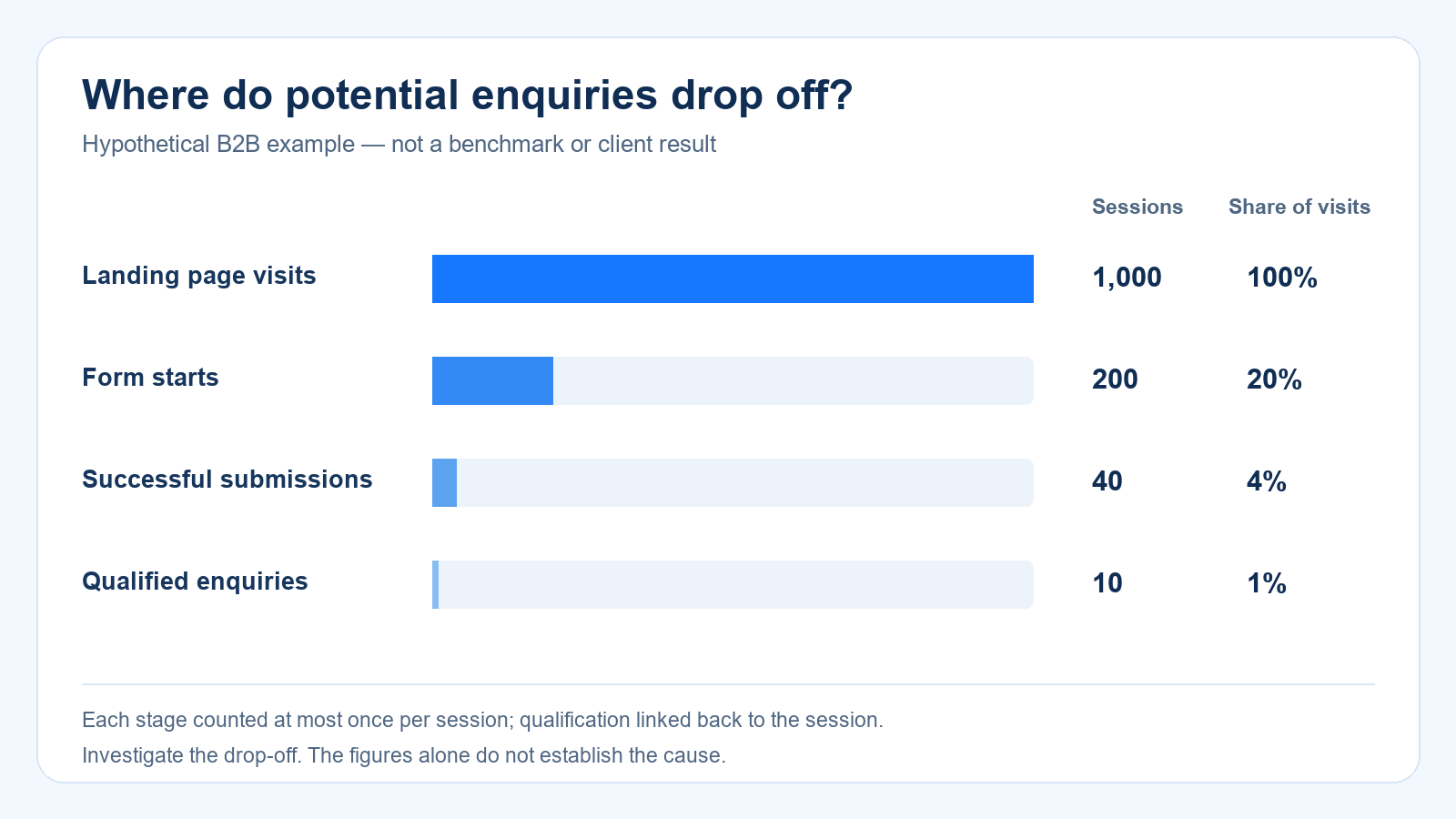
| Stage | Sessions reaching the stage | Share of landing page sessions |
|---|---|---|
| Landing page visit | 1,000 | 100% |
| Form started | 200 | 20% |
| Form successfully submitted | 40 | 4% |
| Enquiry later assessed as qualified | 10 | 1% |
For simplicity, each stage is counted at most once per session, and the qualified enquiries are linked back to those sessions. Raw event counts may produce a different calculation.
- 20% of landing page sessions include a form start.
- 20% of sessions with a form start reach a successful submission.
- 25% of successful enquiries are later assessed as qualified.
These figures identify where to investigate. They do not establish the cause.
A low form-start rate could lead you to examine traffic intent, the offer and how visitors find the form. A drop between form start and successful submission could lead you to inspect validation, required fields and technical errors. A low share of qualified enquiries could lead you to review targeting, eligibility information and how you define a suitable prospect.
Use the same date range, audience scope and counting method when comparing stages. Analytics data may also be incomplete because of consent choices, blocking or implementation problems.
6. Choose One Improvement You Can Evaluate
Once the form works and measurement is credible, write a specific hypothesis. For example:
Visitors arriving from the audit campaign may not understand the deliverables. We will clarify the audit scope beside the form and evaluate whether relevant enquiries increase.
Define:
- The evidence behind the hypothesis.
- The change you will make.
- The primary outcome you will assess.
- A quality check, such as the share of relevant enquiries.
- The review period and limitations.
Avoid changing targeting, headlines, form fields and the offer simultaneously if you need to understand which change contributed to the result.
For a low-traffic B2B website, a short test with only a handful of submissions may not support a reliable conclusion. Start with functional checks and direct usability feedback, then assess changes cautiously. A before-and-after comparison can provide useful context, but differences in traffic, seasonality and campaign activity can affect the result.
Landing Page Conversion Checklist
Before increasing your advertising budget, check that:
- A test enquiry reaches the correct business system and inbox.
- Analytics records the intended action without unintended duplicates.
- Test enquiries and spam are separated from genuine enquiries.
- The ad and landing page describe the same offer.
- The page clearly identifies the intended customer.
- Deliverables and the next step are understandable.
- Supporting claims are accurate and verifiable.
- The form works on mobile and while logged out.
- Required fields have a clear purpose.
- Language and form options suit the intended market.
- Successful submissions and qualified enquiries are measured separately.
- The next proposed change has a clear hypothesis and review method.
Frequently Asked Questions
What is a good B2B landing page conversion rate?
There is no single rate that can determine whether your page is performing well. Traffic intent, the offer, the commitment required and your definition of conversion all matter. Start with a consistent baseline for your own campaigns and include enquiry quality in the assessment.
Should I increase the budget if my ads get clicks but no enquiries?
First verify that the form works, enquiries are being received and measurement is accurate. Then investigate whether the traffic and offer are aligned. More spend alone does not explain or resolve the missing enquiries.
Should I remove fields from the form?
Review fields individually. Remove or defer questions that are unnecessary for the first response, while retaining information needed to assess fit. Evaluate the effect on both submissions and enquiry quality.
Need Help Deciding What to Fix First?
ExpandRight provides project-based performance marketing assessments covering agreed areas such as measurement, landing page messaging and the path to enquiry.
Share your website, target market and the issue you are seeing. We can discuss a suitable scope, deliverables, timeline and fee before work begins.
Prefer email? hello@expandright.com
See how we work before discussing a project.